
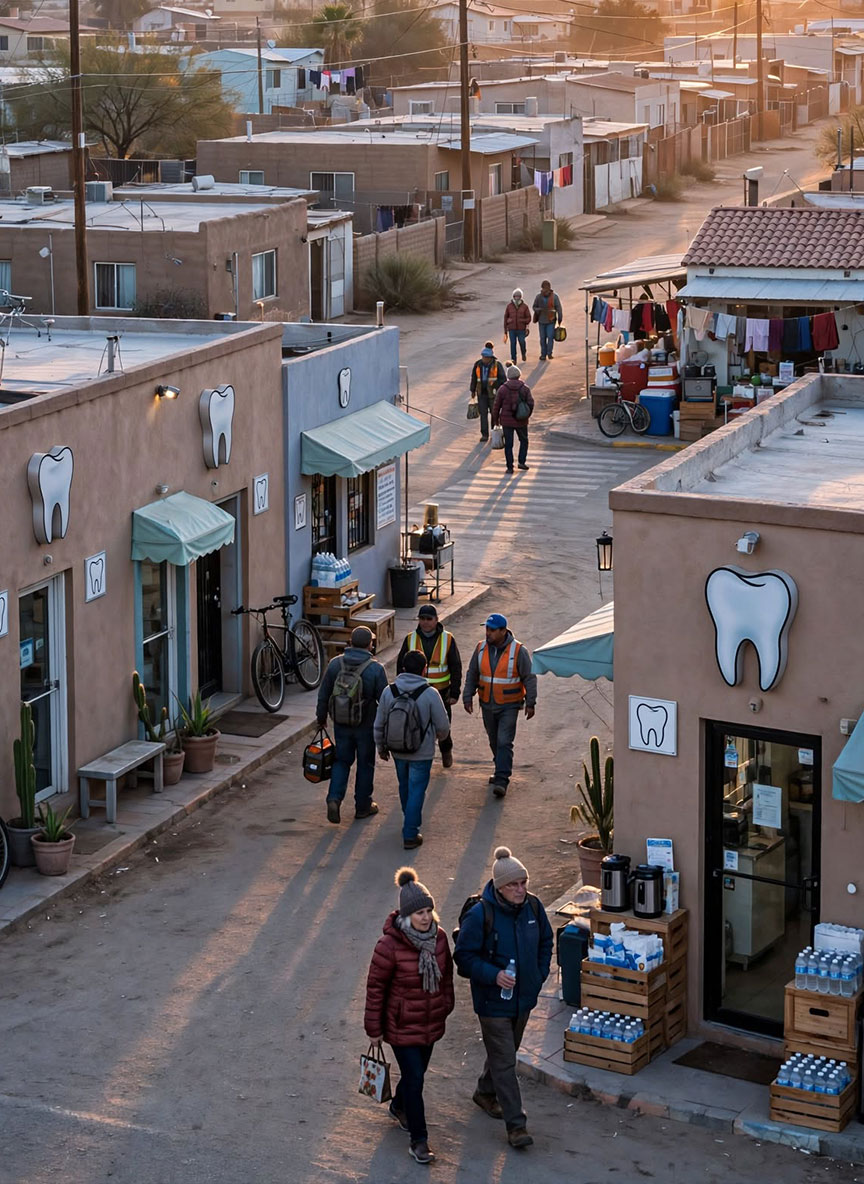
Los Algodones—officially registered as Vicente Guerrero inside the Municipality of Mexicali—is a delegación, not an independent city. That distinction matters: some statistics are tracked for the town itself, while others are published only for the municipality as a whole.
These figures combine Mexico’s 2020 INEGI Population and Housing Census with municipal planning estimates, clinic directories, and local records. Where a number is an estimate rather than a published count, we say so.
The Figures at a Glance
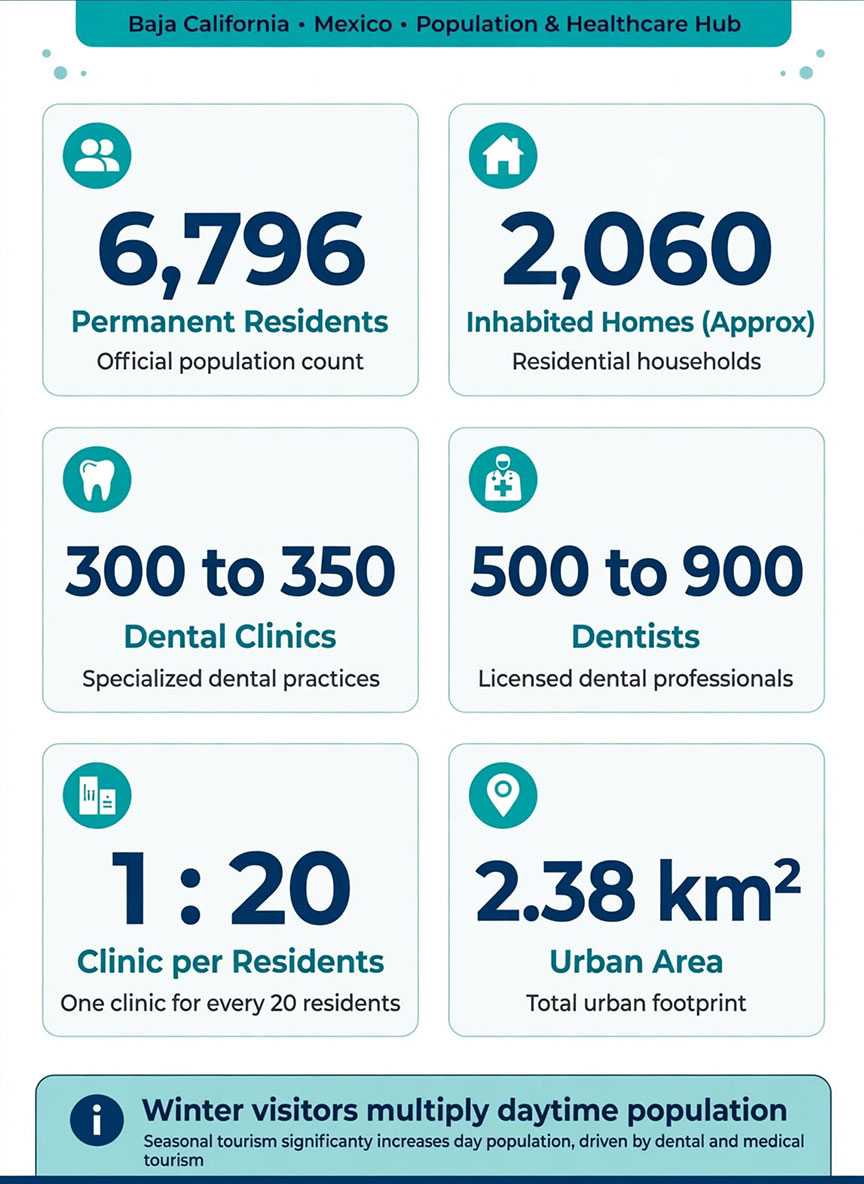
The headline numbers describe a very small place with an unusually large medical economy.
- Permanent population · 6,796: The 2020 census counted 3,460 men and 3,336 women living in the 2.38 km² urban locality.
- Occupied homes · about 2,060: A derived estimate, not a standalone INEGI headline count; local records suggest roughly 2,000 to 2,300 inhabited homes.
- Dental clinics · 300 to 350+: Industry directories and local business registries consistently place more than 300 clinics inside the four-to-five-block commercial core.
- Dentists · 500 to 900: Estimates vary by directory and by whether part-time and visiting practitioners are included.
- Urban area · 2.38 km²: The compact footprint is why so many clinics, pharmacies, shops, and visitors fit into a short walk.
- Residents per clinic · about 20: At roughly 300 to 350 clinics for 6,796 residents, the town has about one clinic for every 20 permanent residents.
Population: 6,796, With a Wider Estimate
The 2020 census recorded 6,796 residents in Los Algodones, up from 5,578 in 2010. That is the most precise official count available for the locality itself.
Later estimates from Mexicali’s planning committee, COPLADEMM, have placed the wider community at roughly 6,800 to 8,600 people. The range reflects different boundaries, surrounding settlements, and seasonal residents—not a contradiction of the census.
Housing: About 2,060 Homes, Derived Not Counted
INEGI does not publish a simple, standalone headline number for occupied homes in Los Algodones; the figure has to be pulled from locality-level database records or calculated.
Using Baja California’s official census average of 3.3 occupants per inhabited home, 6,796 residents works out to roughly 2,060 homes. Local records put the broader range at about 2,000 to 2,300. For scale, the entire Municipality of Mexicali contains roughly 329,356 inhabited homes.
Clinics: 300 to 350 in Four or Five Blocks
Industry directories, including Dental Departures and local business registries, consistently count between 300 and 350+ dental clinics, with roughly 500 to 900 practicing dentists.
That translates to about one clinic for every 20 permanent residents. The range is wide because directories count differently: some include small storefront practices, others only established clinics, and some count part-time or visiting dentists.
Cars: The Number the Town Doesn’t Publish
Neither INEGI nor the state publishes a separate registered-vehicle count for Los Algodones. Vehicle registrations are reported at the municipal level for Mexicali.
The number of cars on the street is a different story. Thousands of U.S.-plated vehicles and daily commuters arrive from Yuma and Mexicali, so the traffic circulating through town is far higher than local resident ownership alone would suggest.
Why the Town Feels Much Larger by Day
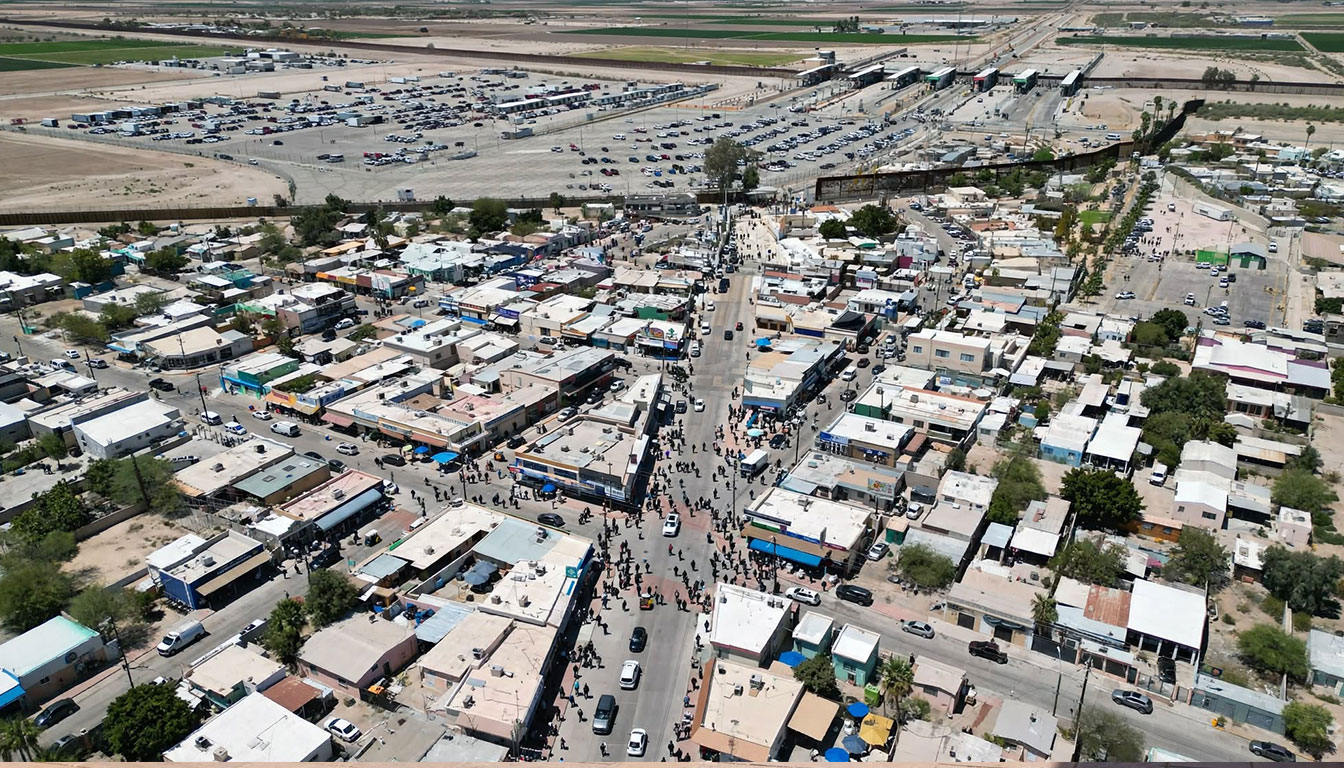
Los Algodones’s resident population is only part of the daily picture. Before the clinics open, workers are already arriving from Mexicali and the surrounding valley.
- A commuting workforce: Hundreds of dentists, hygienists, dental-lab technicians, pharmacists, and shop workers live outside town and commute in each morning.
- The winter surge: From November through April, thousands of American and Canadian winter visitors cross the Andrade Port of Entry daily, temporarily multiplying the daytime population.
What the Numbers Mean
Read together, the figures explain the paradox of Los Algodones: a town of fewer than 7,000 residents supports one of the densest concentrations of dental care anywhere, and its daytime population can look several times its official size.
The 6,796 figure is a census count, the 2,060 homes figure is a calculation, and the 500-to-900 dentist range is an industry estimate. Each is useful—as long as it is not mistaken for a more precise number than it is.
One thing the statistics cannot capture is how the place feels: four or five blocks in which a permanent village, a cross-border workforce, and an international patient flow occupy the same streets.