
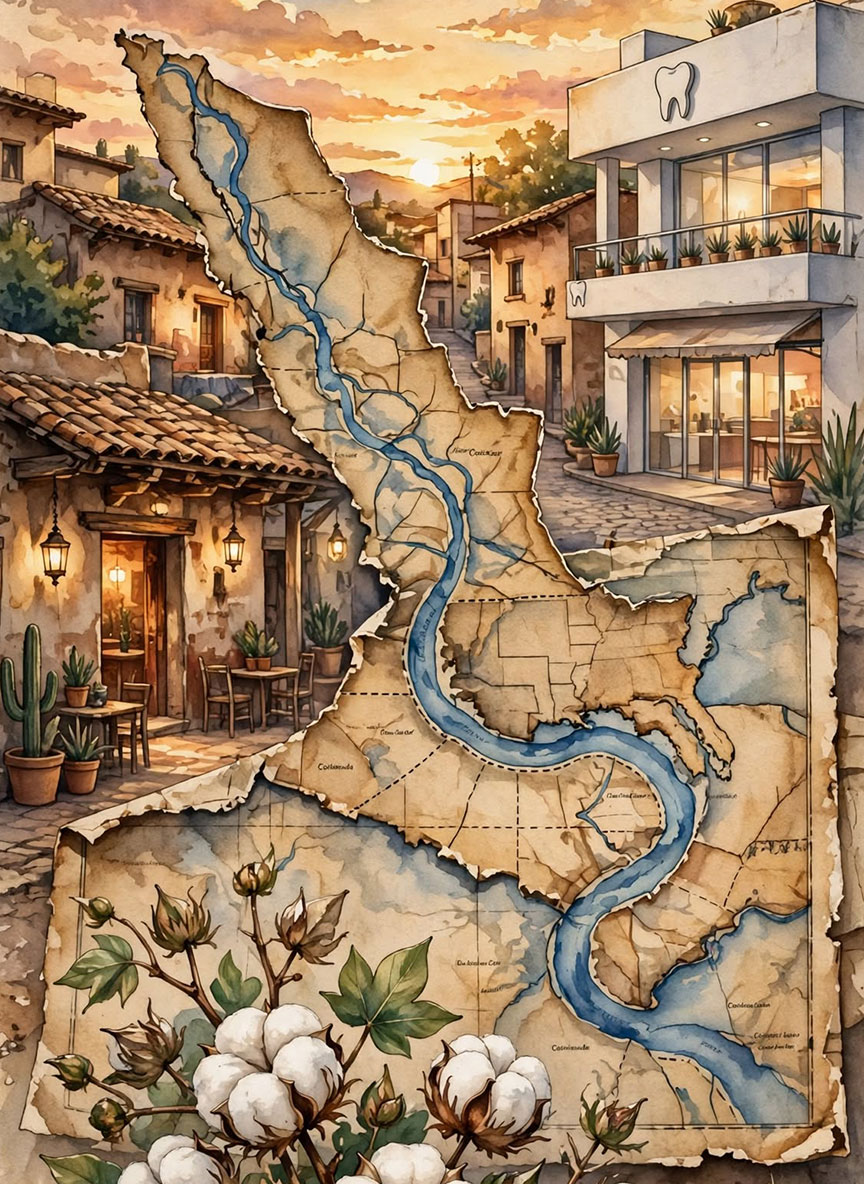
Look closely at a map where California, Arizona, and Baja California meet, and you will spot one of North America’s strangest geographic quirks. Squeezed into a tight bend of the Colorado River sits Los Algodones, the northernmost town in Mexico—and the northernmost tip of all Latin America.
Because of how 19th-century surveyors drew the international boundary around the river’s curve, Los Algodones sits inside a Mexican peninsula jutting into the United States. From the center of town, you can travel due north, east, south, or west and eventually reach the U.S. border. Over the last century, that odd piece of geography—combined with American laws and a single pioneering dentist—drove one of the most dramatic town transformations in border history.
From Wild Cotton to “The Official Cantina of the Valley”
Long before dental clinics lined its streets, the area took its name—Los Algodones, Spanish for “The Cottons”—from the wild cotton that grew along the fertile Colorado River delta. Officially founded in 1894 by farmhands working for retired General Guillermo Andrade, it began as a quiet agricultural and railroad outpost.
Everything changed in 1920, when the United States enacted Prohibition.
Suddenly, thirsty Americans from Yuma, Arizona, and California’s Imperial Valley realized they were only minutes away from legal liquor. Because Los Algodones sat at the junction of two U.S. states and a Southern Pacific rail line, visitors poured across the border by car, train, and foot.
In a matter of years, the sleepy farming settlement boomed into what locals called “The Official Cantina of the Valley”:
- 48 bars in a tiny town: For decades, Los Algodones packed 48 cantinas, saloons, and gambling halls into just a few dusty blocks, alongside little else.
- A magnet for soldiers and locals: Even after U.S. Prohibition ended in 1933, the town’s bar economy kept rolling, fueled by American soldiers stationed at military bases near Yuma and day-trippers crossing over for cheap drinks and burrito stands.
The 1960s Cotton Collapse
By the 1960s, the agricultural backbone that originally built Los Algodones was dying. Upstream dams and heavy water diversions along the Colorado River choked off water flowing into Mexico, while decades of intensive farming exhausted the soil. As the cotton fields withered, the town leaned even harder on its rough-and-tumble cantina reputation—leaving a community of roughly 5,000 people with dozens of bars, rowdy nightlife, and zero dentists.
How One Dentist Shut Down the Bars and Built “Molar City”
In 1969, a young dentist named Dr. Bernardo Magaña, freshly graduated from the National Autonomous University of Mexico (UNAM), arrived in Los Algodones and opened a small clinic right across from the border crossing.
For his first three years, he was the only dentist in town. Word spread quickly among American retirees wintering in Yuma and Southern California that they could walk across the border and get quality dental care for a fraction of U.S. prices. Within a year, Dr. Magaña was treating dozens of American patients a day.
Yet for over a decade, few other dentists followed him because the town’s 48-bar reputation was still too rough. Determined to change that, Dr. Magaña ran for local office and was elected mayor of Los Algodones in the early 1980s. Backed by state authorities in Mexicali, he launched a sweeping crackdown on vice—shutting down the most notorious cantinas, opening schools, and actively recruiting young dentists to set up practices.
The Legacy Today
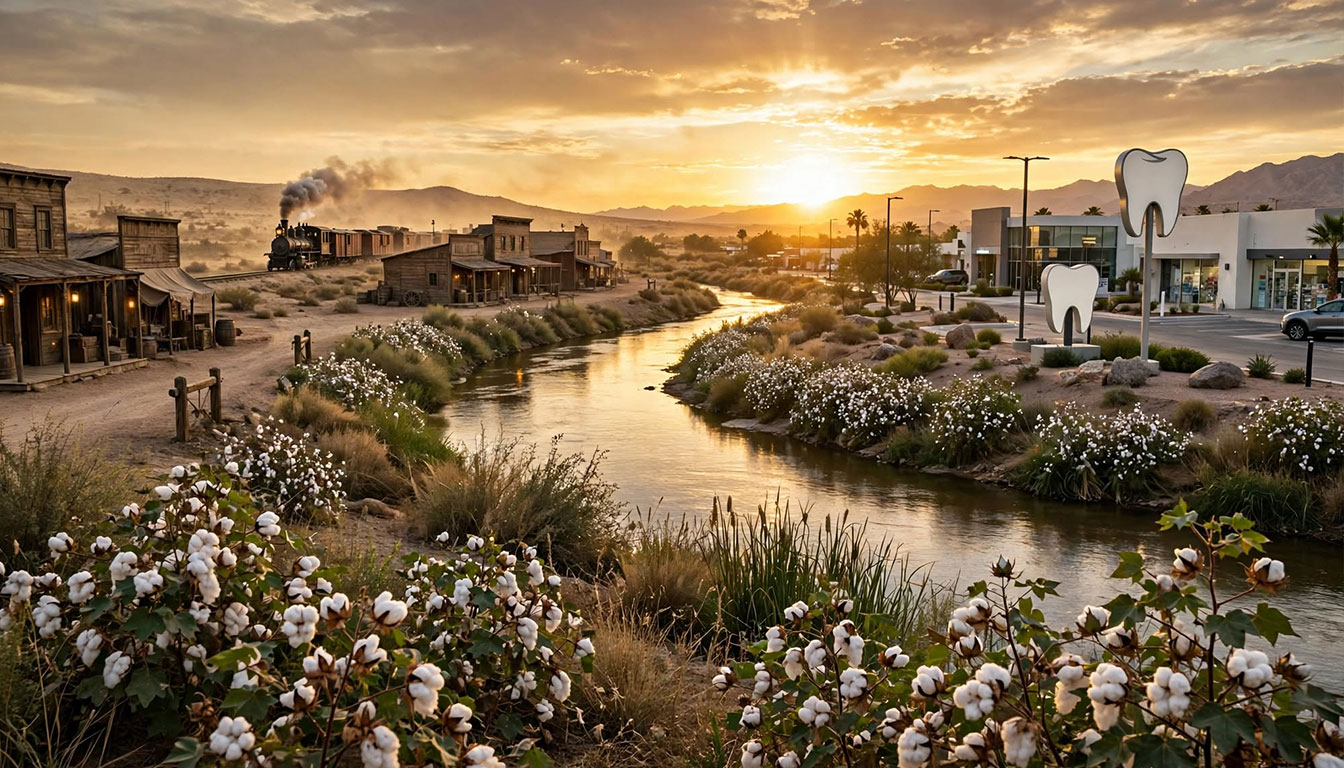
One by one, the saloons on Calle Primera and Avenida A were gutted and turned into dental offices, optical shops, and pharmacies. Today, Los Algodones—a town of fewer than 6,000 residents—is home to more than 300 dental clinics and hundreds of dentists, earning its global nickname, “Molar City”.
Every winter, more than a million visitors cross that same geographic bottleneck where people once went north, east, or south just to find a legal drink—now walking those exact same blocks for crowns, implants, and new smiles.